Introduction:
People don’t wake up wanting to “sell scrap gold.”
They wake up wanting certainty:
What is this worth? Who can I trust? How do I walk away with the most cash today?
This guide from ScrapGoldGuru.com gives you straight talk and simple steps.
No fluff.
No games.
You’ll learn what scrap gold actually is, what drives its price, how to estimate value in minutes, where to sell safely, and how to avoid the traps that cost people hundreds.
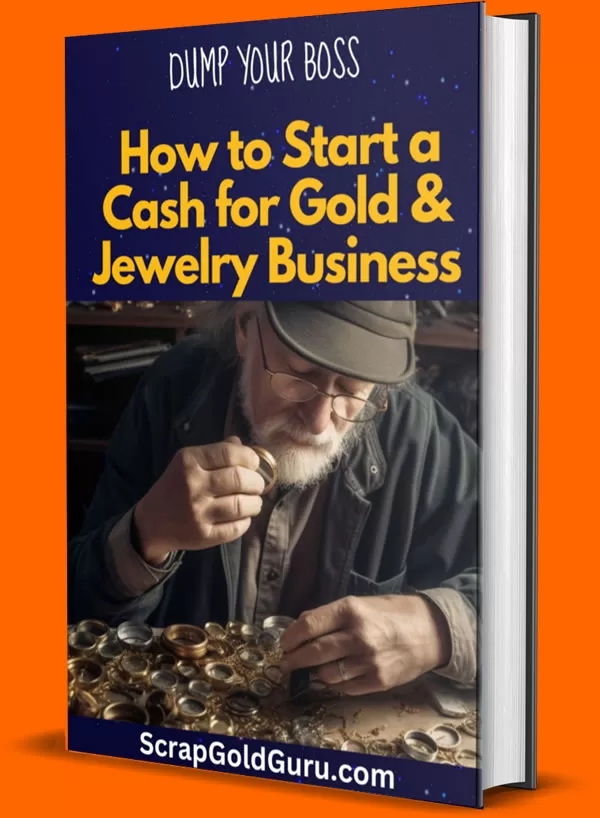
And if the process ignites your entrepreneurial spark, I’ll show you how to turn this knowledge into a real business with our ebook, How to Start a Cash for Gold Business.
What Exactly Is “Scrap Gold”?
“Scrap gold” is gold that’s being sold for its melt value—not for its brand, beauty, or collectability. It’s the raw material a refiner recycles back into pure gold.
Common types:
- Jewelry: Broken chains, single earrings, dented bracelets, class rings, and wedding bands.
- Coins & Bars: Damaged or common bullion may be sold as scrap (but collectible coins often fetch more than melt—more on that below).
- Dental Gold: Crowns and bridges (often mixed with other metals).
- Watch Cases & Findings: Clasps, pins, and casebacks stamped 10K, 14K, 18K, 22K.
- Miscellaneous: Medals, gold wire, and some electronics (consumer-grade electronics rarely pay off for small sellers due to low yield—specialized recyclers handle these in bulk).
Important distinction:
- Solid gold is the real thing throughout.
- Gold-filled has a thick layer of gold bonded to base metal; it has resale value, but far less than solid gold by weight.
- Gold-plated has an ultra-thin gold layer. Its scrap value is usually negligible.
Check for markings like 10K, 14K, 18K, 22K or 417, 585, 750, 916 (European fineness marks). No stamp? It could still be gold—but it needs testing.

What Drives the Value of Scrap Gold?
Several factors determine your payout:
- Spot Price of Gold: The live market price for pure gold (24k). It moves daily. Your items’ value rises and falls with it.
- Purity (Karat):
- 24k = 99.9% pure (0.999)
- 22k = ~91.6% (0.916)
- 18k = 75% (0.750)
- 14k = 58.5% (0.585)
- 10k = 41.7% (0.417)
- Weight: Buyers pay by weight, usually grams, after accounting for purity.
- Buyer’s Payout Rate: Cash-for-gold buyers, pawnshops, jewelers, and mail-in companies each pay a percentage of melt after their costs (overhead, refining fees, risk).
- Resale Potential: Some pieces are worth more than melt (designer brands, intact engagement rings, signed antique jewelry). Those should be sold as jewelry, not scrap.
How to Assess Your Scrap Gold: A Step-by-Step Playbook
Follow these steps to get a realistic estimate—before you visit any buyer:
1) Sort and Identify
- Separate by type: Rings, chains, dental, coins.
- Look for stamps: 10K, 14K, 18K, 22K or 417/585/750/916.
- Use a magnet: Real gold isn’t magnetic. (A weak attraction may indicate a non-gold component like a clasp spring.)
Note: Stamps can be misleading, and some older pieces are unstamped. Professional testing (acid or electronic) provides confirmation.
2) Remove Non-Gold Components
- Take out stones where possible (keep them!).
- Separate clasps that are not gold.
- Note: Some clasps and pins are lower karat than the chain.
3) Weigh Accurately
- Use a digital scale with 0.1 g or better precision.
- Weigh each karat group separately (e.g., all 14K together).
4) Convert Karat to Purity
- Use these decimals:
- 10K = 0.417, 14K = 0.585, 18K = 0.750, 22K = 0.916.
5) Calculate Estimated Melt Value
- Pure gold grams = (Item grams) × (Purity).
- Spot price per gram = (Spot price per troy oz) ÷ 31.1035.
- Melt value (USD) = (Pure gold grams) × (Spot price per gram).
Example (illustrative numbers):
- 20.0 g 14K bracelet
- Spot gold = $2,400/oz (example)
- Spot per gram ≈ $2,400 ÷ 31.1035 = $77.16
- Pure gold grams = 20.0 × 0.585 = 11.70 g
- Melt value ≈ 11.70 × $77.16 = $902.79
A typical local buyer might offer 70–90% of melt depending on competition, volume, and their costs. At 80%, the offer would be about $722.23.
Why not 100%? Buyers must cover refining fees, shipping, metal losses, labor, and business risk.
6) Check for Resale Value Above Melt
Before you sell as scrap, ask:
- Is it a designer brand (Tiffany, Cartier, Van Cleef, etc.)?
- Is it a sought-after style in good condition?
- Does it have appraisal papers or original box?
If yes, consider selling as jewelry (consignment, marketplace, or reputable jeweler). You might make more than melt.
Where and How to Sell Scrap Gold Jewelry for the Best Price
Local Options
- Independent Jewelers & Gold Buyers:
- Pros: Quick cash, face-to-face testing, competitive in areas with many buyers.
- Cons: Offers vary widely; shop around.
- Pawnshops:
- Pros: Immediate payment; sometimes strong buyers for gold.
- Cons: Some pawnshops focus on loans, not gold; offers can be lower.
- Coin Shops:
- Pros: Strong understanding of precious metals; often fair on bullion and scrap.
- Cons: Not all coin shops handle jewelry well (stones, designer value).
How to work with local buyers like a pro:
- Call ahead: ask, “What percent of melt are you paying for 14K today?”
- Ask if you can watch the testing and weighing.
- Bring your own calculation so you can compare offers apples-to-apples.
- Get three quotes within a day to level-set the market.
Online & Mail-In Options
- Mail-In Gold Buyers & Refiners:
- Pros: Convenient; some publish transparent pricing; insured labels.
- Cons: Shipping time; you must read the fine print (fees, minimums, return policy).
- Marketplaces (for resalable pieces):
- eBay, specialized jewelry platforms, or consignment stores can beat melt for designer items, but fees, photos, and patience are required.
Online selling best practices:
- Demand insured shipping (in both directions).
- Get written quotes and a return guarantee (you should be able to decline the final offer).
- Read recent reviews and verify business credentials.

Three (Plus) Actionable Tips to Maximize Your Payout
- Tip #1 — Quote the math, not emotions:
Open with your calculation: “I’m bringing ~20 g of 14K. By my math, melt is ~$903 today. What percentage of melt can you do?” Anchoring to melt keeps the negotiation honest. - Tip #2 — Separate by karat before you go:
Buyers who mix 10K and 14K on the scale can justify a lower blended price. Keep karats separate and labeled. - Tip #3 — Get three offers in 24 hours:
The spread can be hundreds on the same lot. Competition is your friend. - Bonus Tip — Know when not to scrap:
If your ring is from a known designer or in resalable condition, explore consignment or resale first. - Bonus Tip — Keep stones and receipts:
Ask the buyer to remove stones so you can keep them, and photograph everything for your records.
Common Pitfalls That Cost Sellers Money
- Plated vs. Solid Confusion:
“GP,” “GEP,” “HGE,” “RGP,” “Vermeil” = not solid gold. Value is far lower. - Wrong Units on the Scale:
Some buyers quote in pennyweight (dwt); others in grams.- 1 dwt = 1.555 g.
Always convert to the same unit when comparing offers.
- 1 dwt = 1.555 g.
- Letting Buyers Mix Karats:
Mixing 10K with 14K on the scale blurs purity and almost always lowers your payout. - Paying for Stone Weight:
Stones and non-gold parts add weight—but not gold value. Ask for stone removal or deducted weight. - Ignoring Numismatic Value:
Some coins are worth more than melt. If you have older or uncommon coins, ask a reputable coin shop for a numismatic opinion. - Selling Sentimental Pieces on Impulse:
Once it’s melted, it’s gone. If you’re on the fence, wait a day—sleep on it. - No Paper Trail:
Reputable buyers provide a receipt with date, weight, karat, and payment amount. Keep it.
Ethics & the Bigger Picture
Selling scrap gold helps recycle precious metal and reduces the need for new mining. Choose buyers who:
- Test transparently and explain their offer.
- Follow local laws and ID requirements.
- Handle stones and personal items respectfully.
- Offer returns on mail-in deals if you decline the final price.
When both sides are informed and ethical, the transaction is fast, fair, and environmentally sensible.
Quick Reference: Your 60-Second Melt Checklist
- Sort by karat and remove stones.
- Weigh each group in grams.
- Convert karat to purity (10K=0.417, 14K=0.585, 18K=0.750, 22K=0.916).
- (Optional) Check today’s spot price and convert to per gram (spot ÷ 31.1035).
- Melt value ≈ pure grams × spot/gram.
- Target 70–90% of melt depending on buyer competition and your location.
- Get three quotes; choose the best total (not just the best percentage).
Where ScrapGoldGuru.com Fits In
If all you want is a fair sale today, this guide gives you the tools. But if you’re thinking bigger, if you look at that calculation and think, “I could be the buyer, not just the seller,” then it’s time to invest in your knowledge.
- Our ebook: How to Start a Cash for Gold Business shows you, step by step, how to set up legally, price deals, source inventory, negotiate ethically, manage risk, and work with refiners.
- You’ll learn scripts that earn trust, marketing that brings steady leads, and numbers that keep you profitable in any market.
- It’s written to be simple, ethical, and repeatable, the kind of playbook you’ll use every week.
Conclusion
Clarity sells..
Now you have it.
You know what scrap gold is, what moves its price, and how to compute your melt value in minutes.
You know how to shop offers like a pro, what traps to avoid, and when to sell as jewelry instead of scrap.
Take these steps, and you’ll put more money in your pocket every time.
If this guide opened your eyes to the opportunity on the buying side, take the next step.
Invest in our ebook, How to Start a Cash for Gold Business, and turn a one-time sale into a lifetime skill.
The gold isn’t just in the drawer; it’s in what you do next.
