You Found the Right Place.
Now Let's Figure Out Where You're Going.
Two types of people land on this site.
The first runs a payday loan store, a pawn shop, or a car title location. They have foot traffic, a safe, and working capital. They’re watching gold prices climb past $5,000 an ounce and thinking: my customers are walking in with this stuff every day. Am I leaving money on the counter?
The answer is yes. This site fixes that.
The second doesn’t have a storefront yet. They need $500 to $2,000 a month in real, repeatable income — not a gig app, not a course about dropshipping. They want something they can run from a flea market table on Saturdays and scale from there.
Both of you are in the right place.
Pick your path below. Or keep reading. Either way, you’ll know exactly what to do next before you leave this page.
Two Paths. One Business Model. Same Math.
PATH 1: You Already Run a Storefront
You’re a pawn operator, a payday loan store owner, or a car title lender.
You already have the three things that kill most people who try to enter this business: foot traffic, working capital, and a safe. You don’t need a new business. You need a new lane in the one you’re already running.
Adding a gold-buying station to your existing counter is not complicated. It’s a test kit, a scale, a posted payout card, and the playbook that tells you what to pay before the seller sits down.
Start with this: Start a Cash for Gold Business That Works
Then get the guide. Everything else follows from the math.
PATH 2: You’re Starting from Zero
No storefront. No license. Just you, a Saturday, and the question: is this real?
It’s real. The startup kit for a flea market pilot runs under $200 before working capital. A digital scale, an acid test kit, and the formula that tells you exactly what to pay by karat.
One operator ran that play at flea markets for a summer and walked away with $9,000 in profit. No employees. No lease. No overhead beyond the booth fee.
Start with this: How to Start a Scrap Gold Business from Home
Then read the guide before you spend a dollar buying anything.
Who We Are and Why It Matters
We are not content marketers who read about gold buying on the internet.
In 1997, we opened our first payday loan store. In 1998 we added cash-for-gold buying to the counter. In 1999 we started teaching other operators what we’d learned. That teaching became this site and the guide behind it.
We’ve been buying scrap gold inside payday and car title loan operations for over 25 years. We’ve worked with refiners. We’ve fired refiners. We know where operators get hurt, and we built the training to prevent it.
We are the first and longest-running trainer of scrap gold and jewelry entrepreneurs in this space.
The guide is $37. The lessons it prevents cost a lot more than that.
The $37 Guide. Here’s What’s Inside.
“How to Start a Cash for Gold Business” is 100+ pages of operating playbook. Every chapter solves a specific problem. No motivation. No filler. Just the system.
The Foundation. Karat, purity, weight. The three numbers that determine every deal. Get any one of them wrong and the deal costs you money.
How to Test Correctly. Acid testing, electronic testers, and what each method catches that the other misses. Never overpay on a piece that isn’t what the stamp says.
The Payout Formula. Pre-calculated by karat. Run it each morning from the live spot price, tape it to your scale, and make a clean offer in 60 seconds. Confidence closes deals.
Finding and Vetting a Refiner. There are only five or six true refineries in the country. A bad one costs you 8 to 12 points on every settlement. The guide gives you a working refiner list plus the exact questions to ask before you ship a single gram.
Gold Parties. What they are, how to run them, how to pay your hosts, how to fill your calendar with referrals. A real revenue stream for both audiences.
Marketing and Legal. How to attract sellers to your storefront or flea market table. Licensing basics, holding periods, record-keeping requirements, sample forms.
One price. One time. $37. PDF. Instant delivery.
The Math at $5,000 Gold
Gold is trading at $5,000 per troy ounce — roughly $160 per gram for pure 24K.
Most of what you will buy in the field is 14K, which is 58.3% pure. One gram of 14K is worth $93 at spot.
A disciplined buyer pays 65% of melt: $60 per gram. A good refiner pays you back 90% of melt: $84 per gram.
Gross margin on one gram of 14K gold: $24.
On a single 10-gram chain: $240 gross profit.
Karat | Spot Value/gram | You Pay (65%) | Refinery Pays (90%) | Your Margin |
10K | $67 | $44 | $60 | ~$16/gram |
14K | $93 | $60 | $84 | ~$24/gram |
18K | $120 | $78 | $108 | ~$30/gram |
Based on $5,000/troy oz spot price ($160/gram for 24K). Recalculate daily from live spot.
The math only works if you buy correctly and sell to the right refiner. Both are in the guide.
Where to Go Next: Your Reading Path
Do not start at the blog and scroll randomly. Start here. These are the posts that matter most depending on where you are right now.
IF YOU’RE A STOREFRONT OPERATOR
Read these three in order:
The operator-level overview. How the business model works, what you need on your counter, and what separates operators who build margin from the ones who buy problems.
The spread business explained. What the chain shops are doing wrong and how a trained buyer captures the deals they miss.
The buy-side playbook. What to buy, what to skip, and how to build a clean offer before the seller sits down.
After those three, get the guide. Then start buying.
IF YOU’RE STARTING FROM ZERO
Read these three in order:
The zero-to-launch sequence. What you need, what it costs, and how to run the flea market pilot that tells you if this works in your market.
The daily math. What a productive day looks like, what volume produces that number, and what breaks when beginners get sloppy.
The build sequence. Gold parties, referral systems, and how a flea market table becomes a repeatable income engine.
After those three, get the guide. It fills in every gap the blog posts leave open.
Get the Gold Buyer’s Cheat Sheet. Free.
Before you buy your first gram, you need one thing on your scale: the daily payout card.
It shows you exactly what to pay per gram for 10K, 14K, and 18K gold, calculated from the live spot price that morning. Tape it to your scale. Make your offer in 30 seconds. Never second-guess a number in front of a seller again.
Operators use it at the counter. Side hustlers use it at the flea market table. It’s the first tool every new buyer needs, and the one most people spend weeks figuring out on their own.
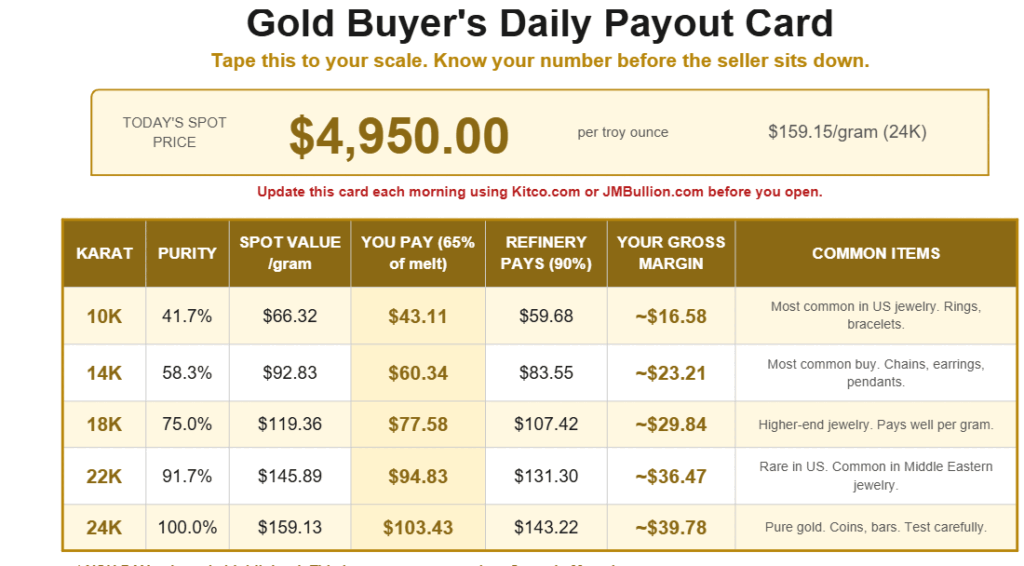
Get Our Gold Buyer's Daily Payout Card. Free.
✓ Pre-calculated buy prices for 10K, 14K, 18K, 22K, and 24K gold
✓ The payout formula — worked example included, ready to run
✓ 6-step field testing checklist before every buy
✓ Works at your storefront counter or a flea market table
Enter your email. The card lands in your inbox instantly.
What People Who Bought the Guide Are Saying
“The purity testing section was exactly what I needed. XRF vs. acid, when to remove stones, how to document. My offers are transparent and repeat sellers come back.”
Precious metals dealer, verified buyer
“I followed the Course by the book. Buying from sellers. Selling to refineries as discussed. The system works.”
James O., verified buyer
“Killing it with Gold Parties. Launched my business according to the directions and haven’t looked back.”
Azis, verified buyer
“I started with jewelry box cleanouts at a flea market. The scripts and intake forms made it easy. What started as a small trial became a reliable income stream.”
Side hustler, verified buyer
One Decision. $37. Everything You Need to Start Right.
The guide is 100+ pages. It covers testing, pricing, the payout formula, refiner vetting, gold parties, marketing, legal basics, and sample forms.
If you buy one deal wrong, you’ve already lost more than $37.
If you pick the wrong refiner on your first lot, you’ve lost a lot more.
This guide exists so you don’t learn those lessons at market prices.
Credit cards, debit cards, and PayPal accepted. Worldwide orders welcome. PDF delivered instantly.
ScrapGoldGuru.com | In the cash-for-gold business since 1998. Training entrepreneurs since 1999.
FAQ 1
Q: How much money do I need to start buying scrap gold?
A: Less than most people think. The testing equipment runs about $75: a digital scale ($25 to $40) and an acid test kit ($25 to $50). That covers you on the vast majority of what you will see in the field.
Working capital is the real number. You need cash to buy the gold before you sell it to a refiner. A flea market pilot can run on $500 to $1,000 in working capital. A buy station inside an existing pawn or payday loan store can draw on cash you already have in the drawer.
The guide is $37. Your first gram of 14K gold at current prices is worth $93 at spot. One good deal covers the cost of the guide and most of your startup kit.
FAQ 2
Q: I already run a pawn shop. Why should I add gold buying separately instead of just doing what I already do?
A: Most pawn operators buy gold informally — whatever comes in, at whatever percentage feels right that day. That is not a system. That is a guess with cash attached.
A dedicated gold-buying station with posted pricing by karat, a calibrated scale, and a payout card built from the live spot price that morning is a different operation. It signals to the seller that you know what you’re doing. It closes more deals. It produces consistent margin instead of occasional margin.
The other reason: a posted gold-buying service attracts sellers who would never pawn anything. They are not your typical pawn customer. They just want to turn unwanted jewelry into cash, and they will walk past three pawn shops to find one that looks like it takes gold seriously.
FAQ 3
Q: What is the difference between a pawn shop’s gold offer and what a trained buyer offers?
A: Pawn shops typically offer 30 to 55% of melt value. They need to cover their overhead, build in a margin for resale risk, and account for the fact that most of their staff is not specifically trained on gold pricing.
A trained buyer working from the payout formula and a live spot price can offer 60 to 70% of melt value, still clear 20 to 25 points of gross margin after the refinery, and close deals that the pawn shop lost. The seller gets a better price. The buyer gets a clean spread. Nobody is losing.
That is the gap the guide teaches you to operate in.
FAQ 4
Q: Do I need a license to buy gold at a flea market or out of my home?
A: It depends on your state. Most states require a precious metals dealer license or a secondhand dealer permit to buy gold for resale. Some states are stricter than others. A few have minimal requirements for small-scale operations.
The guide covers the legal basics: licensing categories, holding period requirements, and record-keeping obligations. The holding period is the piece that surprises most new operators — many states require you to hold purchased items for 15 to 30 days before reselling. That affects your cash flow model, so you need to know it before you buy your first gram.
Verify your specific state’s requirements before you open. The guide gives you the framework. Your state’s regulatory website gives you the current specifics.
FAQ 5
Q: What testing equipment do I actually need to start? I keep seeing expensive XRF machines mentioned.
A: Forget the XRF machine for now. It costs $17,000 and is built for high-volume operations. You don’t need it to start.
Here’s what you actually need on day one:
A digital scale accurate to 0.01 grams: $25 to $40. Non-negotiable. Weight is half the math.
An acid test kit: $25 to $50. Tests karat by karat. Catches plated pieces, gold-filled items, and base metal disguised by a stamp. A $30 kit handles 90% of what you will see in the field.
A 10x loupe: $10 to $20. Reads hallmarks and stamps clearly.
That’s $75 total. Once you have consistent volume — buying several hundred grams a month — you can add an electronic tester ($300 to $500) for speed and an XRF when the margin it saves exceeds the cost to own it. Start with acid. Scale the equipment as the business earns it.
FAQ 6
Q: How do I find a refiner and know if they are paying me fairly?
A: There are only five or six true refineries in the United States. Everything else is a middleman presenting as a refiner. The distinction matters because a middleman takes their cut before passing your gold to the actual refinery — and you pay for that cut in lower settlements.
The guide includes a working refiner list. More importantly, it gives you four questions to ask any refiner before you ship:
What percentage of melt value do you pay, by karat? What is your assay methodology and who performs it? What are your settlement timelines and minimum lot requirements? What documentation do you provide with each settlement?
A refiner who won’t answer those questions clearly before you have a relationship with them is not a refiner you want to be dependent on. The right refiner pays 88 to 92% of melt value on a clean, sorted lot and settles within a predictable timeline.
The difference between a vetted refiner relationship and a lazy one is often 8 to 12 points per settlement. On a $5,000 lot, that’s $400 to $600 gone before you see a check.
FAQ 7
Q: What is a gold party and can it actually make money?
A: A gold party is a home-based buying event. A host invites their friends, family, and neighbors to bring their unwanted gold jewelry. You show up, test and weigh the pieces, make offers, and pay cash on the spot.
They work for one simple reason: sellers who would never walk into a pawn shop or a storefront will sit in their friend’s living room and sell gold they have been meaning to deal with for years. You remove every barrier.
The economics are real. A well-run gold party brings in 8 to 15 sellers. Average transaction is 5 to 15 grams of mixed karat jewelry. At current gold prices, that is $500 to $2,000 in purchases per event with 20 to 30 points of gross margin after the refinery.
You pay the host a commission — typically 10 to 15% of what you buy at their event. They earn without touching any gold. You get a room full of motivated sellers with no advertising cost.
The guide covers the full gold party system: how to recruit hosts, what to say when you arrive, how to handle the weighing and pricing in front of a group, how to build a host referral network, and sample marketing pieces.
FAQ 8
Q: How do I calculate what to pay for gold if the spot price changes every day?
A: The formula is the same every day. Only the starting number changes.
Each morning, check the live spot price at Kitco.com or JMBullion.com. Divide that number by 31.1034 to get the price per gram for pure 24K gold. Then multiply by the karat purity percentage for whatever karat you are buying.
For 14K: multiply by 0.583. That gives you the melt value per gram. Multiply that by 0.65 to get your buy price — 65% of melt is where you want to be on most field purchases.
The Gold Buyer’s Daily Payout Card handles this for you. It is pre-calculated by karat. Every morning you update the spot price, print or note the new buy prices, and tape the card to your scale. Your number is ready before the first seller sits down.
FAQ 9
Q: What is the biggest mistake new gold buyers make?
A: Buying without testing. Every time.
The stamp on a piece of jewelry is not a guarantee. Stamps can be faked. Gold-filled pieces carry legitimate-looking marks. Base metal with gold plating passes a visual inspection every time. The only thing that tells you what you actually have in your hand is an acid test.
A $30 acid test kit. Thirty seconds per piece. That is the difference between a margin-positive deal and buying something that the refiner comes back and tells you is not what you thought.
The second biggest mistake is picking a refiner without asking the right questions. But the testing mistake is faster and more common, and it happens before the refiner ever sees the piece.
Test everything. Every time. No exceptions.
FAQ 10
Q: Is the $37 guide enough to actually start, or will I need to buy more courses or coaching afterward?
A: The guide is enough to start. It covers everything you need to make your first buy correctly: testing, pricing, the payout formula, refiner selection, legal basics, and sample forms.
It does not cover every edge case you will ever encounter. No guide does. What it does is eliminate the expensive beginner mistakes — the bad refiner, the untested piece, the offer made without knowing the math — that cost new buyers far more than $37 in the first 30 days.
After the guide, the only education you need is the experience of making real deals. That is not something you can buy. It is something you build one transaction at a time.
If you hit a specific situation the guide does not cover, the blog at ScrapGoldGuru.com has 50+ posts on sourcing, testing, pricing, and building the business. Most questions are already answered there.